Beginning an occasional series in which I attempt to boost my career by posing with people younger,prettier and more talented.  No.1: Sarah McIntyre.  
Here we are buying each other's books at the Edinburgh International Book Festival.  She's ended up with Fever Crumb; I'm clutching Vern and Lettuce, an album of cartoon strips which first appeared in the David Fickling Comic.  It's about  some animals who live in a tower block in London.  Sarah signed and drew in the copy I bought for Sam, and he loves them and now thinks she's the greatest draw-er EVER.  


The Old, Old Story


A few years ago I got bogged down in the book I was writing, Fever Crumb.  It had a very long and complicated story with multiple points-of-view and a lot of flashbacks, and countless bits of backstory to be explained.  Whatever I did with it, I ended up with characters sitting each other down and explaining great chunks of plot to each other in long, wordy monologues.

So I gave up on it, consigned all existing drafts to the dustbin, and set to work on Something Completely Different.  It eventually ended up being published as No Such Thing As Dragons, which is just about to come out in paperback in the UK, and as a hardback in the US (it's one of the books I'll be talking about at Edinburgh this week).  At the time I wrote it I didn't have publication in mind: I just wanted to write something that wasn't Fever Crumb.  Fever Crumb was long, so Dragons would be short; Fever Crumb had crowds of characters, so I decided the new book would have very few; Fever Crumb kept getting clogged by long speeches, so the hero of this story would be mute: that ought to stop him banging on too much...

I also tried to think of the simplest, most basic story I could.

We are often told that there are only five stories in the world, or only seven, and that all our books, plays and films are a variation on one or other of them.  Some Hollywood writers go further and say that there are only two.  ( 'A man comes to town', and 'a man leaves town'.)  But I think there is one story which is so fundamental that it's probably an echo of the first story ever told.  That's the one I tried to draw on for No Such Thing As Dragons.  It's the story of a small community being threatened, stalked and picked off one by one by a malevolent outside force; and of the hero who eventually arises to save them.  It's Beowulf and St George, but it's also Jaws and Alien.

And to our Pliestocene ancestors it must have been the stuff of everyday life.  Then, small clans of hunter gatherers would have made attractive prey for the bears and big cats with which they shared their world.  It's easy to imagine them clustered around their fires, swapping accounts of the dreadful creatures which had come back again and again to carry off vulnerable members of the group, and of how they were eventually defeated.  The hunters who tracked the predator to its lair and killed it would have been the first literary heroes; forerunners to Odysseus, King Arthur, and that Jamie Lee Curtis out of Halloween.  And as human societies developed and the threat from predators became less immediate we still kept looking over our shoulders in the dark, and glancing uneasily into the shadows beyond the light of our lamps.  We no longer lived in such close proximity to bears and sabre-tooths, so we invented proxy predators to haunt the tales we told; dragons and demons; vampires and xenomorphs.

My first plan was to tell the story of a small band of prehistoric folk getting whittled down by some fell beast - a bear or a sabre-tooth tiger, but one so cunning and so seemingly malevolent that they start to regard it as an evil spirit.  However, that kept coming up much too bleak, and as I turned it over in my mind I was reminded of how, in the Middle Ages and well into the Renaissance, it was believed that dragons haunted the high peaks of the Alps.  And that sparked off another memory, of a story I'd toyed with one day while walking up the Old Man of Coniston*, about dragon-hunters setting off to work on some lonely mountain.  Not St George-ish, knights-in-shining-armour sort of dragon hunters, though; ordinary, flawed, cowardly people who were only in it for the money.  And not a talking, fire-breathing, gold-hoarding dragon but something hungry and primitive; a real animal.  


I took another walk to think it through, then came home and wrote the first draft of No Such Thing... very quickly.  So quickly, in fact, that it completely freed me up and I was able to go back to Fever Crumb, clear out all the dead wood and get to work again, so that's the book that ended up being published first. But I'm still fond of No Such Thing...  It's very different from my other books (although it has a few themes in common with Here Lies Arthur) and if you come to it expecting WOMEishness you may be disappointed: it's really just meant to be a children's book of a slightly old fashioned sort, and I think I'd have enjoyed it when I was nine or ten.  It also features some illustrations by yours truly, some of which I think are quite nice, and a handsome new cover by Mr Wyatt.  I hope you like it.


*Which is a mountain in the Lake District, not an actual old man.  That would be weird.

Teen Ink and EdBookFest

No blogs for the next few days: I've been spending far too much time staring gormlessly into the shallows of the internet, so I'm switching this machine off for a bit, and hope to get some drawing done instead.  However, I was recently interviewed by Rachel Herriman for the Teen Ink website, so if you feel you can't face a week without my penetrating insights and deathless bon mots you can read the results here.  Not only that, but if you can bear the excitement and happen to be near Edinburgh you can see me in person at the Book Festival, where I'll be appearing on the 25th August alongside fellow illustrator-turned-tween-friendly-sci-fi-scribe, Ian Beck.

Atompunk.


The Guardian sat up and noticed Steampunk this week .  The article itself is so cursory that it's barely worth reading, but there are a lot of interesting comments, including one by Lyndon Ap Gwynfryn which echoes my own growing doubts: "Steampunk is the stupidest of all subgenres of speculative fiction...  To retrospectively associate contemporary Victorian science fiction, which was forward looking and progressive, with a self consciously anachronistic and frivolous genre like steampunk is deeply insulting to great writers like Wells and Verne."  
But me and Mr Ap Gwynfryn are clearly pretty much alone in feeling this way, (although one of the other comments says, rather perceptively, "Zzzzzzzz")  There's no point in complaining: the rise and rise of steamy punky things now seems unstoppable.  I can't help wondering, though, why Victorian/Edwardian is the only form of retro sci-fi that seems to appeal to YA authors.  What's happened to the 1950s 'Golden Age' stuff, which you'd think would offer pickings just as rich to a backward-looking world-builder?   
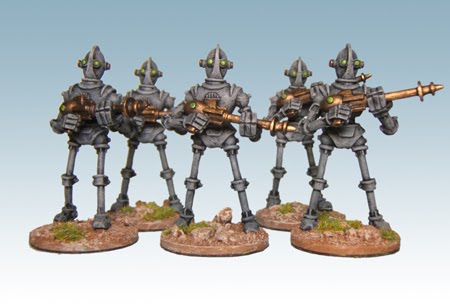
I don't mean the plots (virtually all sci-fi, with the possible exceptions of cyberpunk and that nice Mr Ballard, has basically been re-running the same plots and tropes since about 1930*).  Nor am I talking about the historical context - who cares about that any more?  It's the imagery which I think could fuel a whole series of YA best-sellers.  Skylon-shaped rocket ships, spiny ray guns, perspex-bubble space helmets, flying cars with fins and chrome radiator grilles, square-jawed space-rangers, heroines with beehive-hairdos and cantilevered bras, mad scientists, Nazis... What's not to like?  The movies revisit this look from time to time (Robots, Monsters vs Aliens, bits of the Star Wars prequels), kids' TV loves it (Atomic Betty; the excellent Secret Show) picture books for younger children still use it (Simon Bartram's Man on the Moon for instance) and the tabletop gaming community have clearly brought it on board (check out the lovely 28mm robots from Hydra Miniatures which I've used to illustrate this post).  
So why do we not keep hearing about people rebuilding computers and i-pads in sleek 'fifties housings?  Why are there no no festivals or conventions where like minded 'Atompunks' (as I think they should be called**) can dress up in one-piece nylon numbers and compare the size of their Art Deco disintegrators?***  Above all, why aren't  there scores of books for older children and young adults?  
As with Steampunk, 'Atompunk' offers us arty folk the opportunity to write science fiction without actually needing to know any science. Robert Heinlein may have known his stuff when he wrote all those 'juvenile' space-operas back in the day, but he was awfully right-wing, and who needs to understand gravity and thermodynamics anyway?  This is meant to be fun, so everything works by, you know, atom-power, or some kinda space-diesel.  But it's not just whimsy: the mid-twentieth century flavour of this imaginary era will allow for all sorts of moralising and serious social comment.  Beneath its shiny exterior lurks Sexism!  Racial Prejudice!  McCarthyite witch-hunts!  IT'S ALL, LIKE, A METAPHOR FOR OUR OWN TIMES!  (Naturally the heroes and heroines will be having none of it, and will all share our own, more enlightened views.)
The idea for all this first occurred to me some years ago: I was still writing the Larklight books then, and I spent a pleasant afternoon plotting out a sort of Larklight:The Next Generation, which would swap all the Victorian motifs for Dan Dare ones.  Having done so, however, I didn't want to spend six months actually writing the thing, so I'm passing the notion on to anyone who's interested.  Strap on your jet-pack and rocket boots and set a course for the Lunar Academy: you could become the JK Rowling of the Jet Age!


*Not that there's anything wrong with that, mind.

**I just made up 'atompunk', but sure enough when I googled it I found that it actually does exist.  Sigh...

***...which means that there probably are.